The Malaysian Nature Society Kuching Branch
(MNSKB) and the Sarawak Artists Society (SAS) organised a visit to Bako
National Park as a lead up to the conference of the Parties to the United Nations Framework Convention
on Climate Change. This trip was supported by the Sarawak Forest Department
The visit, which was on September 27, 2015,
introduced SAS members to the beauty of the park while providing artistic inspiration.
The artwork will be displayed in Kuching at
The Spring on the 2nd and 29rd November. Then it will be shown at the conference
of the Parties to the United Nations Framework Convention on Climate Change in
Kuala Lumpur from 21st November to 20th December.
Rose Au Deputy Chair of the MNSKB led the
group through the mangrove forests that edged the cliffs. These forests are often wrongly thought
of being muddy wastelands; in reality they are thriving beautiful communities.
Sebastian Jong, SAS secretary, said he
thought the mangroves were just plants, but they have strength that we never knew
about.
Jong said, "They are stronger than
anything else by the shore and can stand firm again a tsunami."
The group while sketching saw an
international visitor stuck in the mangrove mud and immediately went to show
her the way to hard sandy mangrove area where they were drawing.
Rose Au said that this was a warning of
hazards and that all visitors should remain with their guides and groups. They should not strike off on their
own. All members of the group were
glad she was safe.
Mary Margaret, MNS member,
said that this trip was an exciting opportunity to connect with, be inspired by
the stunning Bako National Park and the natural world.
You are invited to a talk by our member Kim Edwards on The Heart of Borneo Highlands Eco Challenge she attended in July 2015.
Date: Wed 11 Nov 2015
Time: 7.30 PM
Venue: UCSI University, Kuching. Lot 2498, Block 16, Kuching Central Land District, Jalan Tun Jugah, 93350 Kuching, Sarawak
Abstract on the talk:
...In the footsteps of our ancestors. An adventure that relives history, culture and the stewardship of nature. The Heart of Borneo Highlands Eco Challenge was all that it promised to be.... and more!
The adventure began in the quaint and stunning cluster of villages of Ba’Kelalan on July 24th and ended in the picturesque and epicurean town of Bario. What transpired in between was not for the faint-hearted but certainly for those who seek adventure, untouched beauty, local knowledge, physical challenges and insights into Sarawak’s highland cultures, history and forests.
About me:
Kim is Australian and has been living in various parts of Asia and travelling the globe since she graduated from university 20 years ago. Whilst working in Tokyo, she happened upon a dashing Orang Ulu - French man in Tokyo and he beckoned her to Malaysia. After a wonderful stint in Kuala Lumpur, family and a need for the outdoors and adventure for their three boys bought them to her husband, Alexis’, hometown of Kuching. They have been residing here for just over one year and they and their family are loving every minute of it.
In Kim’s previous life she worked as a Senior Manager in Compliance for HSBC, Tokyo and HSBC, Cyberjaya. As part of HSBC’s corporate social responsibility programme, Kim was lucky enough to be chosen to take part in a grey whales conservation project in Baha California, Mexico. The challenge of consulting took her into the clutches of PricewaterhouseCoopers for a time until the world of babies called her back home.
While being a mummy she retrained as a Primary teacher and has been loving the challenge of educating the next generation. In Kuching, Kim has kept herself busy with being a mother and leading the initiative of bringing life and soft skills training to the underprivileged under the banner of PurpleLily Girls.
Admission to talk is free. So bring along some friends. Just register with
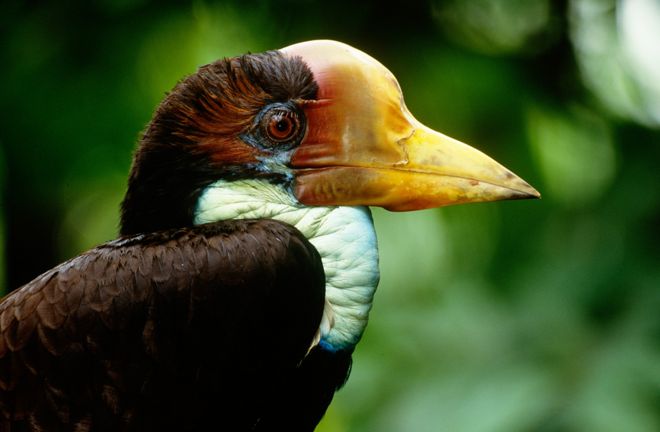
The illegal trade in elephant tusks is well reported, but there's a type of "ivory" that's even more valuable. It comes from the helmeted hornbill - a bird that lives in the rainforests of East Asia and is now under threat, writes Mary Colwell.
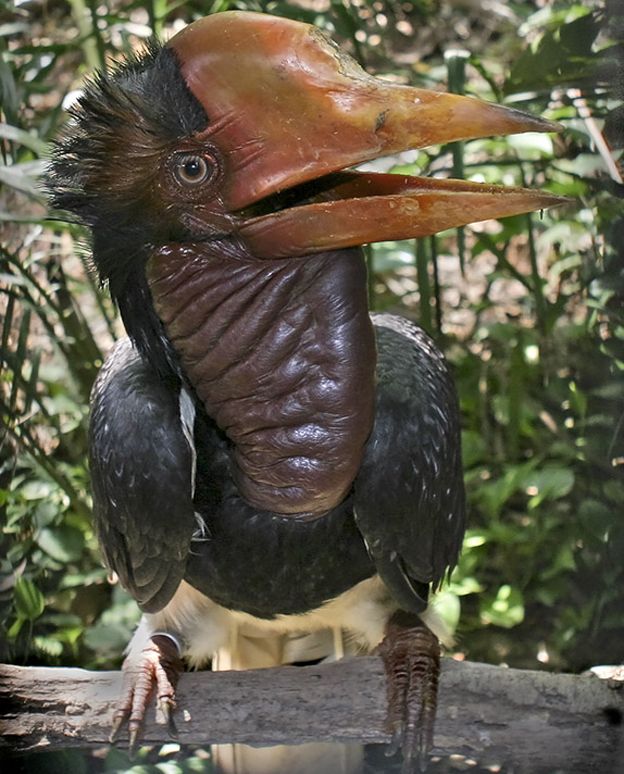
It wouldn't be wise to go head to head with a helmeted hornbill. They weigh 3kg and have their own built-in battering ram - a solid lump of keratin (a fibrous protein) extends along the top of the bill and on to the skull. This "casque" can account for as much as 11% of a bird's weight.
In all other species of hornbill - there are more than 60 in Africa and Asia - the casque is hollow, but the helmeted hornbill's is solid. The males use it in head-to-head combat and both sexes use it as a weighted tool to dig out insects from rotting trees.
Helmeted hornbills live in Malaysia and Indonesia. On the islands of Sumatra and Borneo their maniacal calls and hoots resonate through the rainforest. They tend to eat fruit and nuts and are often referred to as the "farmers of the forest" as they spread seeds widely in their droppings.
They have a wingspan of up to 2m (6ft 6in), striking white and black feathers and a large patch of bare skin around the throat. They have a reputation for being secretive and wary, though, and you're more likely to hear them than see them.
Image copyrightScience Photo Library
They have good reason to be shy - thousands are killed each year for their casques, shot by hunters who sell the heads to China.
Between 2012 and 2014, 1,111 were confiscated from smugglers in Indonesia's West Kalimantan province alone. Hornbill researcher, Yokyok Hadiprakarsa, estimates that about 6,000 of the birds are killed each year in East Asia.
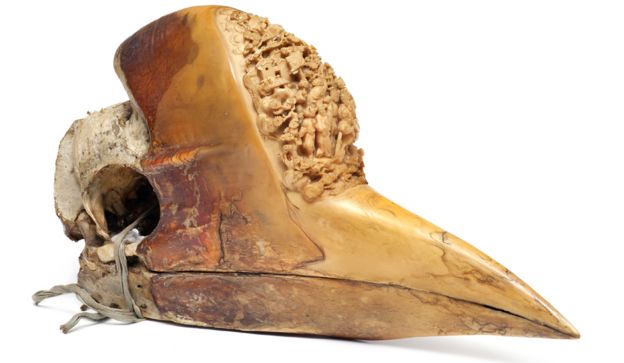
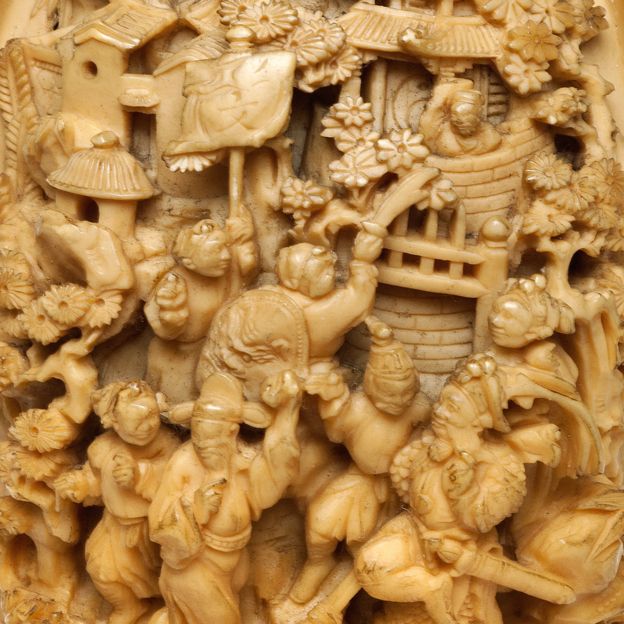
The casque, for which hunters are willing to risk arrest and imprisonment, is sometimes referred to as "ivory". It's a beautiful material to carve, smooth and silky to the touch, with a golden-yellow hue, coloured by secretions from the preen gland - most birds use their heads to rub protective oils from this gland over their feathers, legs and feet.
For hundreds of years it was highly desired by Chinese craftsmen who made artefacts for the rich and powerful, and by Japanese netsuke carvers who made intricate figures for the cords on men's kimonos. Many of these objects made their way to Victorian cabinets in the UK when netsuke collecting became fashionable in the 19th Century.
Image copyrightScience Photo Library
"There are some records that showed the hornbill ivory was presented to the shogun," says Noriku Tsuchiya, curator of the Japanese section at the British Museum. "Unfortunately by the early 20th Century the hornbill became very rare because of hunting and now legal trade is limited to certified antiques."
Illegal it may be, but trade continues undercover, and hornbill ivory is worth about £4,000 ($6,150) per kilogram - three times more than elephant ivory. The killing of Africa's elephants and rhinos for their tusks and horns is well reported, but the helmeted hornbill's plight often slips under the radar. "If no-one pays attention, this bird is going to become extinct," warns Hadiprakarsa.
The helmeted hornbill has been culturally significant for thousands of years - it is the mascot of West Kalimantan and the Dayak people of Borneo believe the bird ferries dead souls to the afterlife, acts as a sacred messengers of the gods and consider it a teacher of fidelity and constancy in marriage. Killing it is taboo.
But it's not just hunting that threatens this slow breeding creature - its habitat is also under pressure. As the appetite for palm oil grows in the West, developers are encroaching on Asia's rainforests. Researchers at the National University of Singapore estimate that Borneo and Sumatra are losing nearly 3% of their lowland rainforest every year.
As a result, the helmeted hornbill "is considered Near Threatened, and should be carefully monitored in case of future increases in the rate of decline," according to the International Union for Conservation of Nature.
So the bird faces a double whammy - losing its head to ivory carvers and its home to supermarket products. I'm not sure I fancy its chances.
KUCHING: Malaysian Nature Society Kuching Branch, in collaboration with the state Ministry of Tourism, is organising the Sarawak Bird Race 2015 on Nov 1 at Borneo Highlands Resort.
Sarawak, unfortunately, is not as well known as a birding destination as Peninsular Malaysia or Sabah. Borneo Highlands Resort, an important bird area since 2010, is one the more accessible location to see Sarawak’s rare and endemic birds.
This resort borders Kalimantan, at the 1,300-metre ridge that marks the international boundary. It is located about an hour’s drive from Kuching in the Penrissen Highlands.
Four out of the eight species of hornbills found in Sarawak (10 species are found in Malaysia) have been seen here. These are the Black, Rhinoceros, White-crowned and Wreathed Hornbills.
MNS Kuching vice-chairperson Rose Au said rare birds found at BHR included Blue-banded Pitta, Pygmy White-eye and Bornean Barbet. All together, up to 201 species had been recorded.
These birds could be seen along the forest trail that skirts the cliff.
This is a great chance for experts and novice birders to be part of citizen science. The data collected will be incorporated into the world database on birds. This information is a way of measuring the health of the environment.
This is an exciting opportunity for experienced and novice birders to improve their identification skills while making positive scientific contributions.
Meanwhile, registration for the Sarawak Bird Race is open.
For more information and for those who want to join the race contact the society at mnskuching@gmail.com or call Rose Au at 016-8909468 or Eddy Wong at 014-3951415.
KUCHING: The Malaysian Nature Society Kuching Branch (MNSKB) and the Ministry of Tourism Sarawak will be organising the Sarawak Bird Race 2015 on Nov 1 at the Borneo Highlands Resort (BHR).
The Sarawak Bird Race is a fun competition between teams of two to observe, identify and record as many species of birds as possible within a specified time frame.
Its vice chairperson Rose Au said that the race should get individuals from the Sarawak Tourist Guides Association and Sarawak Forestry Corporation Park Guides excited about birding.
“It also provides an opportunity for all bird enthusiasts to improve their bird identification skills,” she said in a press release yesterday.
BHR is in the Penrissen Highlands, which was declared an Important Bird Area in 2010 since it hosts several endemic and endangered species. It is part of the global network created by Birdlife International.
According to the society’s chairman Vincent Wong, over 200 species have been recorded at the resort located at the Sarawak-Kalimantan border.
Katherine Pearce, an MNS member, said that the border was also a good place to see the iconic hornbills. The data collected from the Bird Race will be incorporated into a database for bird populations.
Au hopes that the Beginners Birding Workshop, which will be held at BHR a day before the race from Oct 29 to 31, will lead to responsible guiding of birds, thus resulting in the protection of birds and their habitats by the participating tourist guides.
For more information or to join the race, contact MNS Kuching Branch at mnskuching@gmail.com or call Rose Au at 016-8909468 or Eddy Wong 014-3951415.